
A live-cell uptake platform that runs on equipment you already trust
The DrugUptech screening platform follows compound accumulation in living cells in real time, without lysis, washing, radiolabelling or chemical modification of the compound.
Accumulation read as depletion from the medium, using a proprietary fluorescent reporter
The platform operates in two detection modes and picks the right one for each compound during set-up:
- Displacement mode. The reporter responds to the compound directly. Works for a broad range of chemotypes with no intrinsic fluorescence.
- Direct mode. For compounds that fluoresce in the detection window, such as fluoroquinolones and tetracyclines, their own emission is followed.
Both modes give a complete kinetic profile from a single well, rather than a series of independently prepared endpoints.
Readouts that change decisions
% accumulation
Fraction of applied compound associated with cells, normalised to benchmarks run on the same plate.
Kinetics
Uptake rate, half-time and plateau from a one-phase association fit to the live trace.
Efflux contribution
Energy supplementation separates active efflux from reduced permeability.
Viability & efficacy
Optional MIC, growth or cytotoxicity readouts alongside uptake, so potency and accumulation are compared directly.
Assay at a glance
- Format
- Black 96-well plates, standard fluorescence plate reader
- Compound requirements
- Unmodified, no label; typically µM working concentrations
- Limit of detection
- Around 150 nM for reporter-responsive compounds
- Time to first data
- Minutes for bacteria; hours for mammalian cells and tissue
- Solvent tolerance
- Up to 0.5% v/v DMSO; ethanol preferred where soluble
- Compound scope
- Screened against a library of 55 clinically approved drugs across diverse chemotypes
- Readouts
- % accumulation, kinetics, efflux contribution, viability or efficacy
- Technology readiness
- TRL 6: validated in relevant laboratory environments, pilot studies ongoing
Organisms and cell systems already on the platform
We can also set up your own strains, cell lines or tissue as part of a project.
Gram-negative bacteria
- Pseudomonas aeruginosa PA01
- Acinetobacter baumannii AYE
- Klebsiella pneumoniae
- Escherichia coli
Gram-positive & fungi
- MRSA
- Staphylococcus epidermidis
- Mycobacterium smegmatis
- Candida albicans
- Candida tropicalis
Mammalian cells
- Caco-2 (intestinal epithelium)
- HEK293T
- Further lines set up on request
Plant systems
- Arabidopsis Col-0 protoplasts
- Leaf discs from any plant species
- Plants & protoplasts page
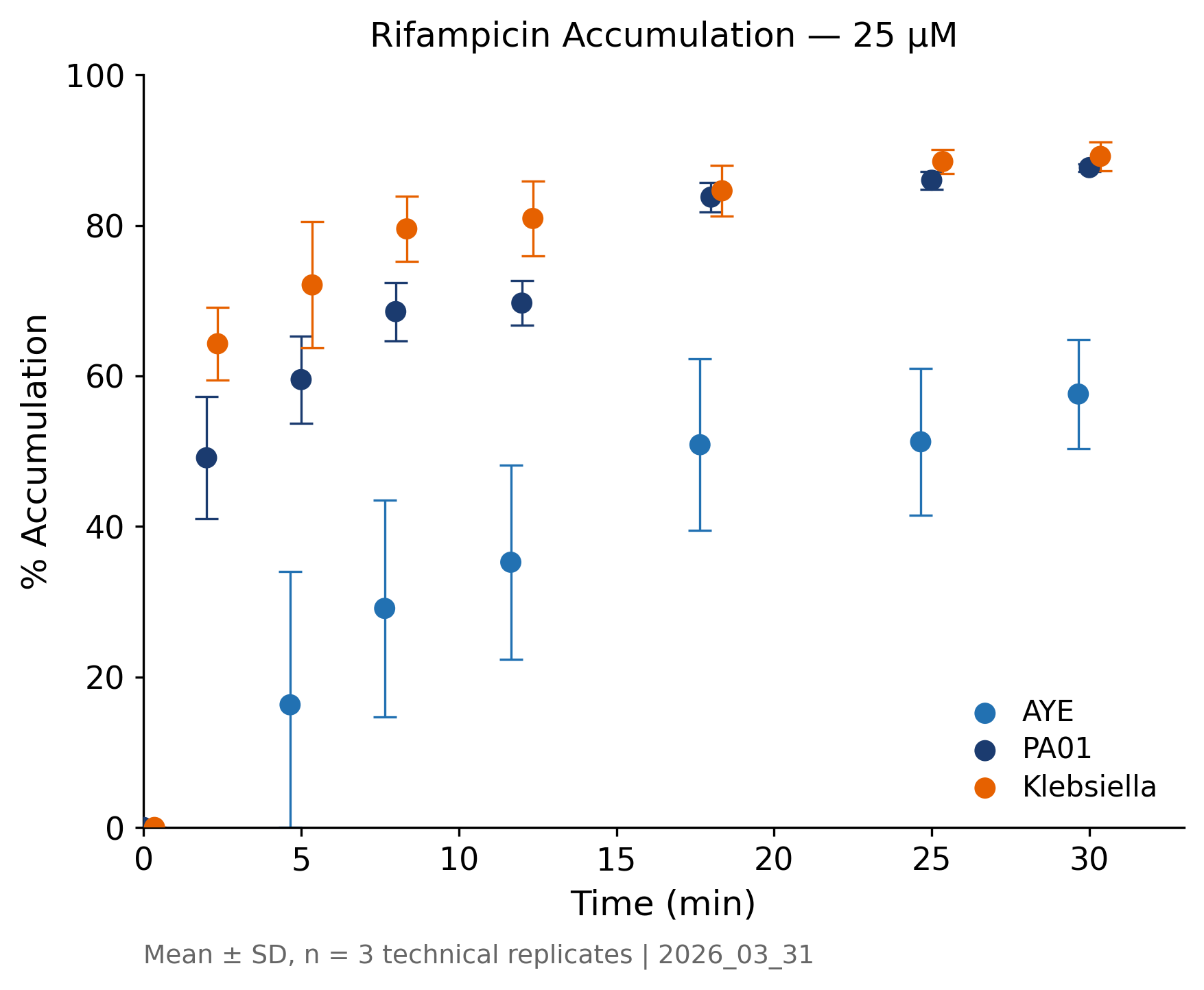
Two mechanisms, one symptom. We tell them apart.
Reduced permeability and active efflux both leave less compound inside the cell, so an accumulation deficit alone does not say which is the problem. Because our readout is kinetic and cheap to repeat, we can change the cell's energy state and watch the response. Adding glucose fuels proton-antiporter pumps: if accumulation drops, efflux is the culprit.
See the full datasetHow it compares with existing accumulation methods
| Capability | DrugUptech | LC-MS/MS lysate assays | Radiolabelled uptake | PAMPA / Caco-2 permeability |
|---|---|---|---|---|
| Real-time kinetic data | Yes | No, endpoints | No, endpoints | Limited |
| Unmodified compound | Yes | Yes | Needs label | Yes |
| Live, intact cells | Yes | Lysed | Washed pellets | Artificial or monolayer |
| Bacteria and fungi | Yes | Yes | Yes | No |
| Plant cells and tissue | Yes | Rare | Rare | No |
| Standard plate reader only | Yes | Mass spectrometer | Scintillation counting | Yes |
| Throughput and scalability | High | Medium | Low | High |
Want to run your compounds on the platform?
Send us a shortlist and the organism or cell system you care about. We will confirm detection mode and propose a scope within a week.